
Why Security Guard Staffing Is Becoming Essential for Business Continuity in Japan
Japan’s security industry is facing serious labor shortages and an aging workforce. This article explains why companies that can recruit, train, manage, and dispatch reliable security guards are becoming essential partners for construction companies, facility operators, event organizers, and other businesses.
Article Content
Why is security guard staffing becoming so important in Japan?
Japan’s security industry is facing a major human resources challenge. Demand for security guards remains high at construction sites, roadwork areas, commercial facilities, office buildings, apartment complexes, event venues, parking lots, logistics centers, and public spaces.
At the same time, many security companies are struggling to secure enough workers. If a company cannot provide the required number of guards on the required date, the problem is not only a staffing issue. It can affect site safety, construction schedules, facility operations, event management, and even the client company’s ability to continue business smoothly.
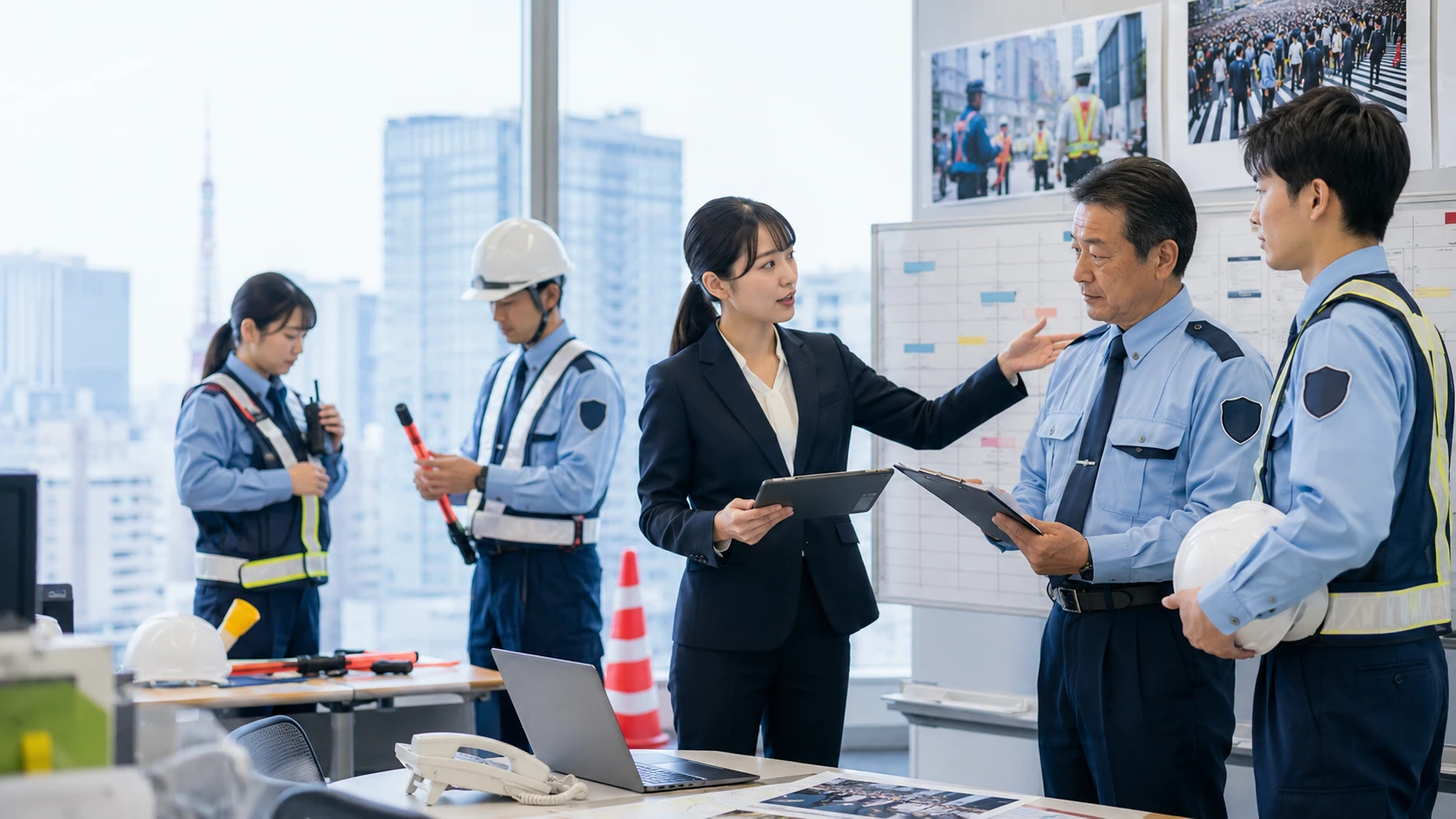
This is why the role of a security company is becoming broader than simply “placing guards.” Today, strong security companies must build a system that can support clients through recruitment, training, shift management, emergency replacement, site coordination, and stable human resource supply.
Security companies are becoming human resource partners
Security work is still a people-centered business. Technology such as AI cameras, remote monitoring, and digital reporting tools can support operations, but many security tasks still require human judgment, communication, and on-site presence.
At construction sites, guards must guide pedestrians and vehicles safely while understanding the movement of trucks, workers, machinery, and nearby residents. At event venues, guards must manage crowds, guide visitors, reduce congestion, and respond calmly to unexpected situations.
In these environments, a security company is not just an outside vendor. It becomes a human resource partner that supports the client’s daily operations and helps prevent delays, accidents, and confusion.
The real value of staffing security guards to other companies
Many companies need security services but do not want to recruit, train, schedule, and manage guards by themselves. A construction company wants to focus on construction. A facility operator wants to focus on building management and customer service. An event company wants to focus on planning and operations.
This is where security guard staffing becomes valuable. The security company handles the human resource side: finding workers, training them, assigning them to suitable worksites, managing shifts, confirming attendance, and responding when sudden changes happen.
The value is not only “sending people.” The true value is understanding the client’s site conditions and creating the right security structure based on headcount, working hours, risk level, traffic flow, visitor volume, site layout, and emergency needs.
Main worksites that depend on security guard staffing
1. Construction sites and roadwork areas
Construction sites and roadwork areas require careful safety management. Vehicles enter and leave the site, pedestrians pass nearby, materials are delivered, and heavy machinery may be operating.
Security guards guide pedestrians and vehicles so that construction can proceed safely and smoothly. If guards are not available, the site may face safety risks, delays, or difficulty continuing work as planned.
For construction companies, a security partner that can reliably provide guards on the necessary dates is highly valuable.
2. Commercial facilities and office buildings
Commercial facilities and office buildings require entrance control, reception support, patrols, security camera monitoring, visitor assistance, nighttime security, and emergency response.
In facility security, attitude and communication skills are especially important. A guard who responds politely and calmly can improve the sense of safety and trust for visitors, tenants, employees, and building owners.
3. Events, festivals, and sports venues
Event security requires crowd guidance, entrance and exit control, parking lot guidance, restricted-area management, and emergency support.
Since event dates are fixed, staffing must be reliable. If there is a sudden absence or not enough guards on the day of the event, the entire operation may be affected. This makes emergency staffing capacity especially important for event security.
4. Parking lots, logistics centers, and warehouses
Parking lots and logistics facilities need vehicle guidance, gate management, truck flow control, pedestrian protection, and accident prevention.
At logistics centers, vehicle traffic may increase during certain hours. Security guards help organize movement and reduce the risk of contact between vehicles, workers, and pedestrians.
What security companies need to provide stable staffing
1. Strong recruitment ability
The first requirement is recruitment strength. Security companies need to attract many types of workers, including experienced guards, beginners, seniors, younger workers, part-time workers, full-time workers, and people looking for flexible schedules.
Because it is difficult to rely only on experienced guards, companies must create an environment where beginners can start with confidence. Clear job descriptions, flexible workdays, training, and supportive supervisors all help improve recruitment.
2. Training and education
Security guards must receive proper training before working at a site. The knowledge required for traffic guidance, facility security, crowd control, and patrol work differs depending on the job.
A company with strong training can provide greater confidence to clients. Guards who understand safety rules, legal requirements, manners, reporting procedures, and emergency response are more likely to perform professionally at the site.
3. Accurate shift management
Shift management is one of the most important parts of security guard staffing. Managers must confirm who is assigned to which site, what time they must arrive, whether qualifications are required, whether the commute is realistic, and whether the schedule is physically manageable.
Poor shift management can lead to lateness, absences, double booking, communication mistakes, and client dissatisfaction. Accurate and flexible shift control is essential for stable service.
4. Emergency replacement capacity
Unexpected absences are a reality in security work. A guard may become sick, experience a transportation delay, or face a family emergency.
When this happens, the company’s ability to quickly arrange a replacement determines whether the client’s site can continue operating safely. A security company that can respond to vacancies quickly provides strong reassurance to clients.
5. Understanding each client’s worksite
Staffing is not only about filling a number. A security company must understand the site location, traffic flow, risk points, client requests, nearby residents, time schedule, and work environment.
A company that understands the site can advise the client on how many guards are needed, which areas require stronger coverage, and what type of guard is suitable for each position.
Benefits for client companies
1. Clients can focus on their core business
Recruiting, training, scheduling, and managing security guards requires time and expertise. By outsourcing security staffing to a specialized company, clients can focus on their main business activities.
Construction companies can focus on construction. Facility operators can focus on building management. Event companies can focus on planning and visitor experience.
2. Guards can be secured only when needed
Security needs differ by project. Some sites need guards every day, while others need support only for a short-term project, one-day event, nighttime shift, busy season, or temporary increase in traffic.
Security companies can provide flexible staffing according to each client’s schedule and site conditions.
3. Easier response to sudden staffing needs
There are many situations where guards are needed suddenly: additional construction work, an increase in event visitors, facility trouble, traffic changes, or unexpected absences.
If the security company has a strong staffing network and management system, the client can respond to sudden changes more easily.
4. Better safety management
Trained security guards help improve safety at the site. They guide pedestrians, manage vehicles, patrol facilities, assist visitors, report incidents, and support emergency response.
For clients, this reduces operational risk and helps create a safer environment for workers, visitors, tenants, and nearby residents.
A good staffing system must also support the guards
To provide stable staffing to clients, security companies must also create a work environment where guards want to continue working.
Important factors include flexible workdays, clear wages, proper training, consultation support, reasonable commuting distance, appropriate site assignment, and consideration for age and physical condition.
This is especially important for senior workers and beginners. If guards feel supported, they are more likely to stay with the company, improve their skills, and provide stable service to clients.
The value of a security company is not only the number of guards
Having many registered guards is important, but it is not enough. The real value of a security company is the ability to assign the right person to the right site at the right time.
Some guards are strong in traffic guidance. Some are better suited for facility reception. Some are experienced in event security. Some can handle night shifts. Some are good at calm communication with visitors and residents.
A strong security company understands each guard’s strengths and places them where they can perform best. This improves service quality for clients and creates better working conditions for guards.
What client companies should check before requesting security staffing
When choosing a security staffing partner, clients should check the following points:
- Can the company respond to sudden absences or additional staffing needs?
- Can it support traffic guidance, facility security, event security, and parking guidance?
- Does it provide proper training for guards?
- Does it understand site-specific risks and propose suitable staffing plans?
- Can it advise on the necessary number of guards and placement locations?
- Does it have a clear shift management and attendance confirmation system?
- Can it support both short-term and long-term projects?
- Is communication smooth before, during, and after the assignment?
Human resource strategy will shape the future of the security industry
As labor shortages continue, security companies must strengthen their human resource strategies. It is no longer enough to simply recruit people. Companies must hire, train, support, retain, and assign workers in a way that matches both client needs and guard capabilities.
Security companies will also need to welcome more diverse workers, including seniors, beginners, younger workers, part-time workers, foreign residents, and people looking for flexible schedules.
For client companies, this creates a clear difference between security providers. A company with strong staffing capacity can support construction progress, facility operation, event safety, and emergency response more reliably.
Frequently asked questions
Q. Can a company request security guards for only one day?
It depends on the security company and the worksite conditions, but many companies can support short-term or one-day security needs. This is common for events, temporary construction work, parking guidance, and special facility operations.
Q. Can guards be arranged urgently?
Some security companies specialize in quick response and emergency staffing. To improve the chance of successful arrangement, clients should provide the date, location, number of guards, working hours, and job details as early as possible.
Q. What types of sites can security guards be assigned to?
Common sites include construction sites, roadwork areas, commercial facilities, office buildings, apartment buildings, event venues, parking lots, logistics centers, and warehouses.
Q. How should a client decide how many guards are needed?
The necessary number depends on site size, entrances and exits, pedestrian flow, vehicle flow, working hours, risk points, and visitor volume. It is best to consult a security company and create a staffing plan based on the actual site conditions.
Conclusion
In Japan’s security industry, labor shortages and an aging workforce are making stable guard staffing more important than ever. Companies that can recruit, train, manage, and dispatch reliable security guards are becoming essential partners for client businesses.
The role of a security company is not only to send people to a site. It is to support safety, business continuity, and smooth operations through human resources.
Behind every construction site that continues safely, every event that runs smoothly, and every facility that operates with confidence, there are security guards and a staffing system that supports them.
👉 The future value of security companies will depend not only on placing guards, but on using human resources to support the business operations of client companies.